
Flue Integrity Test
A camera shows a crack. We measure whether it leaks. Our most complete non-destructive chimney evaluation, with a pressure-tested flue and measured liner thickness. $849.
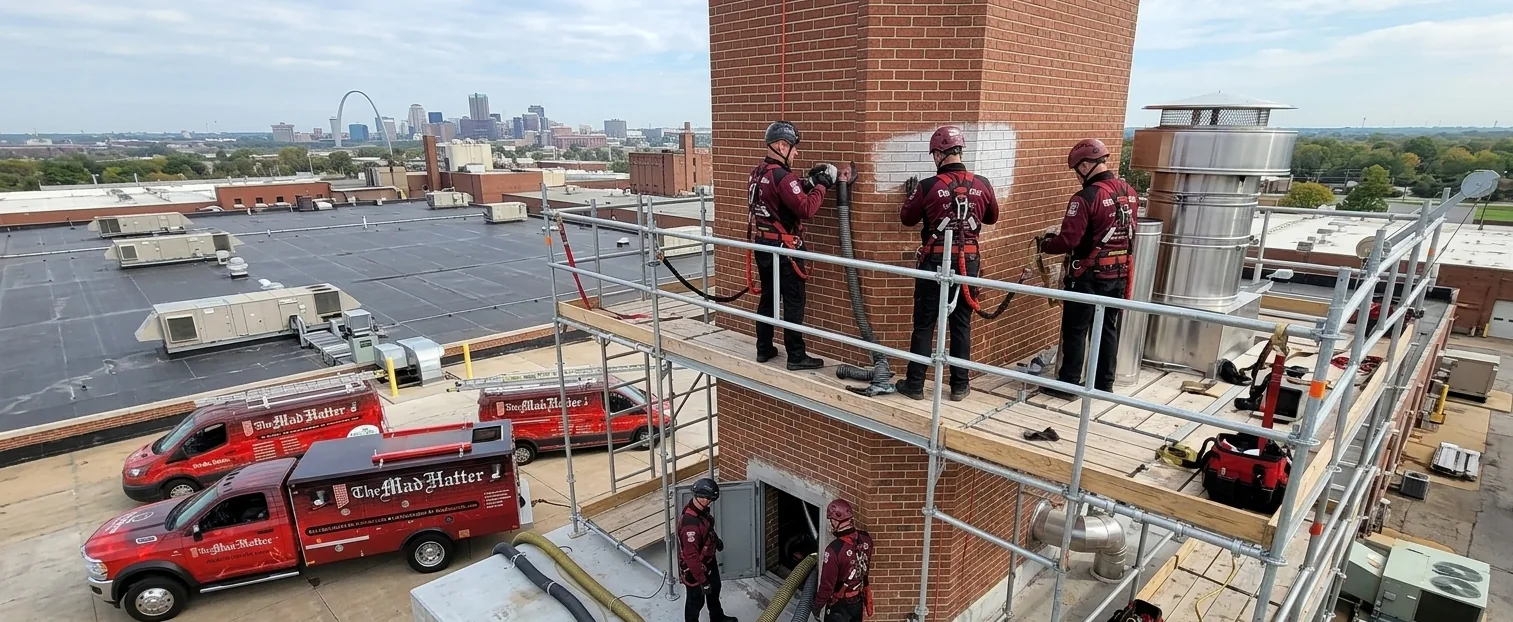
Get the Numbers Before You Spend Thousands
Replacing a chimney liner is a major decision. So is trusting an old one. Most inspections can only show you what a flue looks like. The Flue Integrity Test measures how it performs: how much the flue leaks under pressure, and how much metal your liner has left.
It includes everything in The Mad Hatter Hearth Diagnostic Plus Analysis, including a complete NFPA 211 Level 2 inspection. Every hearth inspection is based on St. Louis City & County and St. Charles City & County currently adopted municipal code.
See it. Measure it. Prove it.
Our camera inspections let you see the flue. Hearth Diagnostic Plus measures heat, moisture, and draft. The Flue Integrity Test proves how the flue performs.
See it: the condition of the flue, roof, attic, and foundation.
- Sweep and internal camera scan
- Rooftop, attic, and foundation inspection
Measure it: everything in Level 2, plus instrument testing.
- Heat Load & Thermography Analysis
- Moisture mapping
- Draft and laser clearance measurements
Prove it: everything in Hearth Diagnostic Plus, plus flue performance testing.
- Flue leakage test
- Ultrasonic liner thickness readings
- Written report with all readings and images
What's Included
- Complete NFPA 211 Level 2 inspection: sweep, internal camera scan of the flue, and rooftop, attic, and foundation inspection
- Heat Load & Thermography Analysis: a controlled heat load in the firebox, documented with a FLIR thermal imager
- Moisture mapping around the chimney to locate hidden water intrusion
- Draft and laser clearance measurements, including chimney height and roof clearance
- Flue leakage test with a Wöhler DP 600 leakage tester
- Liner and metal thickness readings with an Elcometer PTG8 ultrasonic gauge
- Aerial roof imaging of the crown, cap, and flashing when the roof is too steep or unsafe to walk
- Written report with measured values, thermal images, camera stills, and photos
How the Flue Leakage Test Works
After the flue is swept and scanned, we temporarily seal the top and bottom of the flue. The leakage tester then holds the flue at a set test pressure and measures how much air it has to supply to keep that pressure steady. A tight flue needs very little air. A flue with cracks, open joints, or a separated liner needs more, and the reading tells us how much.
That matters because a flue that leaks can let smoke and combustion gases, including carbon monoxide, escape into walls, the attic, or living spaces instead of venting outside.
How Liner Thickness Is Measured
Stainless steel liners wear from the inside as acidic condensation from wood, gas, and oil appliances eats at the metal. A camera can show rust or discoloration, but it can't tell you how much metal is left. Our ultrasonic gauge sends sound through the metal and measures its thickness without cutting or drilling, so you know whether your liner has years of service left or is wearing thin.
Your Results, in Plain Numbers
U.S. codes do not set one pass/fail number for flue leakage, so we don't hand you a vague pass or fail. Your report shows the measured leakage at the stated test pressure, the thickness readings and where they were taken, and what those numbers mean for your system. If we reline or repair your chimney, the original readings become a baseline for testing the finished work.
Thinking About Chimney Liner Replacement?
Replacing a chimney liner is one of the bigger repairs a homeowner faces, so the decision should rest on evidence, not a quick look. If you've been told your liner needs replacing, the Flue Integrity Test shows whether the flue actually leaks and how much metal a stainless liner has left. If replacement is needed, your report explains exactly why, and our UL-Listed chimney relining estimate is free. If it isn't, you've avoided an expensive repair you didn't need.
Buying or Selling a Home
NFPA 211 calls for a Level 2 chimney inspection on the sale or transfer of a home, and the Flue Integrity Test includes a complete Level 2. It's the right choice when a home inspection report recommends further evaluation of the chimney, when an older liner is in question, or on high-value purchases where buyers and sellers want measured results to negotiate with. See our page for real estate chimney inspections.
After a Chimney Fire
A chimney fire can crack flue tiles and warp or split metal liners, often without visible damage from the outside. The Flue Integrity Test shows whether the flue still holds pressure and whether liner metal has thinned. For insurance claims, our Chimney Fire Damage Assessment & Claim Report documents the damage and the repairs needed. Call today for your free estimate.
Best For
- Deciding whether to reline: you've been told you need a new liner and want proof first
- Installing an insert or stove into an existing chimney
- Older stainless liners that may be wearing thin
- After a chimney fire, when you need to know whether the flue still holds
- High-value home purchases and multi-flue or commercial buildings
- Verifying a relining project after the work is done
Already Booked a Different Service?
If a technician finds open mortar joints, cracked tiles, or liner seam separation during a routine service, the Flue Leakage Test is available as a $295 add-on. We explain it and get your approval before any testing begins. Not sure which service fits? Try our Service Finder.
Frequently Asked Questions
It is our most complete non-destructive chimney evaluation. It includes everything in The Mad Hatter Hearth Diagnostic Plus Analysis, including a complete NFPA 211 Level 2 inspection, and adds a flue leakage test and ultrasonic liner thickness readings.
A camera shows the surface of the flue, such as a crack or an open joint. The leakage test shows whether the flue actually leaks: we seal it, hold it at a set test pressure, and measure how much air it takes to keep that pressure.
U.S. codes do not set a single pass/fail number for a flue leakage test. Your report lists the measured leakage at the stated test pressure, explains what it means for your system, and gives a baseline that can be compared after a repair or relining.
No. Every part of the Flue Integrity Test is non-destructive. The flue is temporarily sealed for the leakage test, and the thickness gauge reads the metal with ultrasound, without cutting or drilling.
We take thickness readings on stainless liners, connectors, and metal components wherever they can be reached, usually at the top of the liner and at the appliance connection. Sections that cannot be reached are listed in the report as not measured.
We confirm roof access, the number of flues, and the liner type by phone first so the right equipment comes to your home. Call 636-946-1622 to schedule.
No. A Level 3 inspection under NFPA 211 involves opening parts of the building or chimney to see concealed areas. The Flue Integrity Test measures flue performance without opening anything.
Schedule Your Flue Integrity Test
Flue Integrity Tests are booked by phone so we can confirm roof access and liner type first. Call 636-946-1622, Monday through Friday 8 AM to 4 PM and Saturday 9 AM to 1 PM.